klik.villas
Building a PMS specifically for Asian villa rental operations
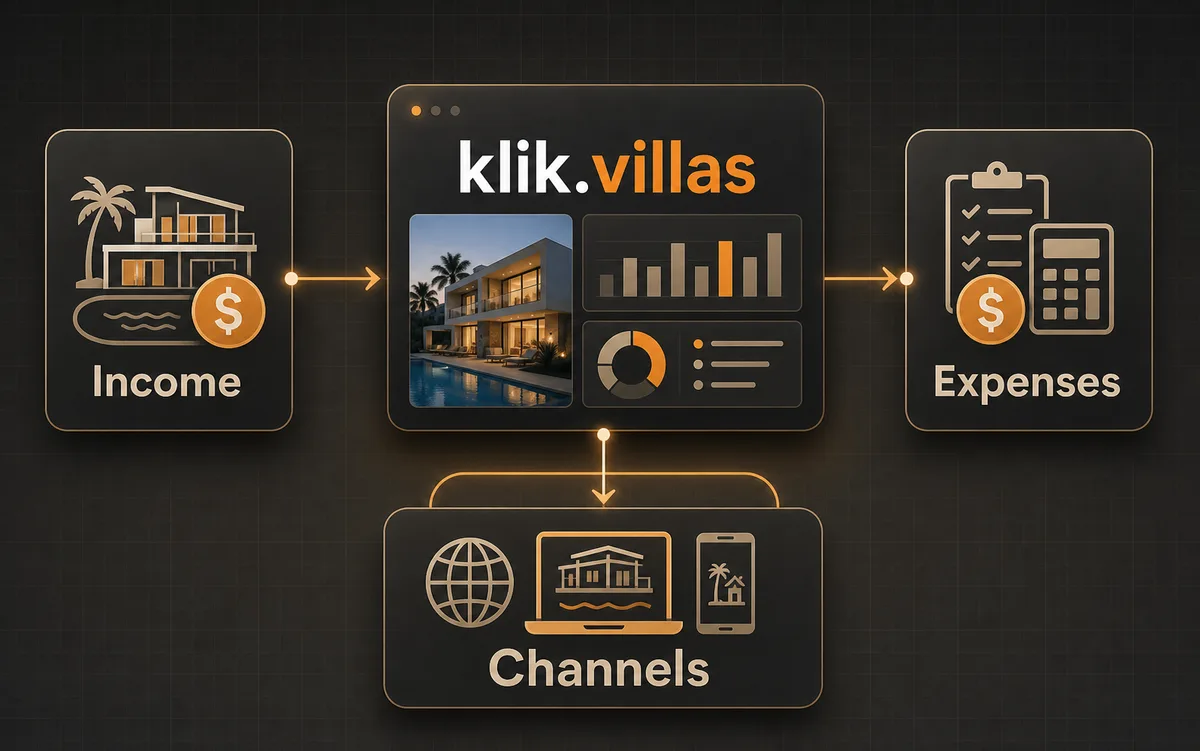
Launched in 2011, klik.villas was Asia's first villa rental PMS, built specifically for Asian properties. By the time it was sold in 2022, it managed about 2,500 properties from across Asia, used mostly by villa management companies and also by individual owners.
- Status
- Sold in 2022
- Period
- 2011–2022
- Region
- Asia
- Industry
- Villa rental PMS and property management
The challenge
After the earlier villa rental websites, the next problem was operational. Many rental businesses still handled reservations, income, expenses, maintenance, owner reporting, and channel updates in spreadsheets. That created duplicated work, weak overview, and a high risk of inconsistent data. On Thailand-villas.com, every enquiry still had to be forwarded to the owner by hand, because we could not see the owners' bookings ourselves.
My role
I developed and maintained the technical system behind klik.villas from 2011 to 2022: backend logic, database structure, rental workflows, and the integrations that helped villa rental businesses move from manual administration to a web-based operating system.
What I built
- Built PMS logic for listings, reservations, rental income, expenses, taxes, maintenance, and operational data.
- Built one of the first integrations with Booking.com and Agoda, alongside channel-manager style connections such as Rentals United.
- Imported availability from calendars managed in other tools through iCalendar feeds.
- Added a sync log and an additional iCal calendar as a fallback after finding that syncs removed existing calendar entries instead of merging with them.
- Automated the Thailand-villas.com enquiry flow once the owners' bookings were visible in klik.villas.
- Created data structures for management companies, property owners, booking channels, and internal administration.
Outcome
klik.villas grew to about 2,500 properties from across Asia. As one of the first integrations with Booking.com and Agoda, we were treated as a valued partner and invited to their offices in Bangkok. In 2016 we merged with Rentivo, and in 2022 klik.villas and Thailand-villas.com were sold together to another company, ending my involvement after 11 years of development and maintenance.
What the project taught me
- The hardest problem was availability kept somewhere else. Many properties managed their calendars in other tools and shared them as iCalendar feeds, and we did not sync those feeds often enough. An iCal feed is only fetched periodically, so between syncs a date could look free in one system after it had already been booked in another.
- A worse problem was a sync that replaced existing calendar entries instead of merging with them. We added a sync log, so every change a sync made could be traced, and an additional iCal calendar as a fallback.
- The lesson: a calendar sync has to merge rather than overwrite, and every change it makes has to be traceable. When a sync goes wrong, the result can be a double booking with a real guest on the way.
- Building a PMS for Asian villa properties meant the data model and workflows had to reflect how villa rentals actually operate, rather than adapting a hotel system designed for another market.
Why it remains relevant
The same problems still appear whenever a business outgrows spreadsheets or connects several systems that all claim to know the truth: availability, bookings, and money have to have one owner, and every sync between systems has to be visible and recoverable.
Related work and guides
Need help replacing spreadsheet-based workflows?
I turn manual processes into practical web systems, integrations, and backend workflows. The focus is not software for its own sake, but stable tools that fit how the business actually works.