- Published
- Updated
Reliable API integrations
An API integration often looks simple in a development environment: send a request, receive a successful response, and store the result. Production is less tidy.
Requests time out after the receiving service has already completed the operation. Webhooks arrive twice or out of order. Access tokens expire. One system accepts a change while another rejects it. A provider changes a field, slows down, or becomes unavailable.
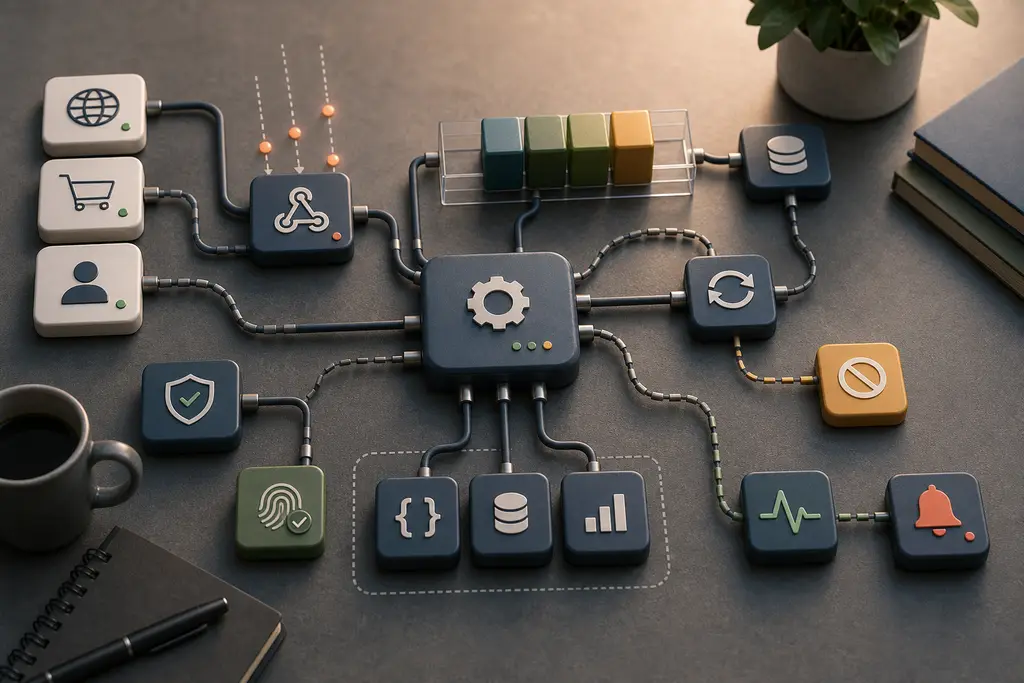
A reliable integration is designed around those conditions. The successful request is only one path through the system. The difficult work is making failures visible, controlled, and recoverable.
This guide explains the general engineering pattern. The same principles apply when planning a booking website, connecting a contact form to a CRM, or running Laravel queues and background jobs.

Define the contract before writing the connection
Two systems need more than an endpoint and an API key. They need a shared understanding of data and behavior.
Document:
- Which system owns each piece of data
- Which events create, update, or delete records
- Required and optional fields
- Allowed values and formats
- How records are matched across systems
- What happens when data is missing or invalid
- Expected response codes and timeouts
- Rate limits and usage constraints
- Authentication and permission requirements
- Versioning and change-notification expectations
Ownership is especially important. If a customer’s email address is changed in both a CRM and a booking system, which value wins? Without a clear answer, a technically successful synchronization can still overwrite correct information.
Treat the contract as maintained project documentation. When either system changes, the integration should be reviewed against it.
Booking and reservation flows expose ownership problems
Booking, reservation, and service workflows make integration problems visible quickly. A public website may connect to an availability calendar, booking engine, channel manager, payment provider, CRM, email platform, analytics tool, and internal operations system.
A reservation that appears on the website but not in the operational system is not a small synchronization detail. Staff may promise unavailable capacity, miss a payment state, send the wrong confirmation, or spend time reconciling records manually.

Define the authoritative source for each important state:
- Which system owns availability?
- Where does a reservation become confirmed?
- Which system owns customer details?
- Where is the external booking or payment reference stored?
- Which system sends confirmations and operational notifications?
- What happens when one system accepts a change and another rejects it?
Ownership should be specific enough that staff know which system to trust during a mismatch. Integration code should preserve external references and keep provider-specific logic behind a clear boundary, because APIs, fields, channels, and operational workflows change over time.
Monitoring must cover the business result as well as the technical request. A successful response does not prove that availability, payment status, confirmation, and back-office records agree. Periodic reconciliation provides a final check when real-time events are delayed or missed.
The klik.villas property-management system case illustrates why availability, property data, integration boundaries, and operational follow-up need to work as one system rather than as isolated API calls.
Assume timeouts are ambiguous
A timeout does not always mean that an operation failed.
Imagine sending a request to create an order. The receiving service creates it, but the response is lost before your system receives it. If the request is repeated blindly, the customer may get two orders.
That is why integrations need to distinguish between:
- A request that definitely failed before processing
- A request that may have completed but returned no confirmation
- A request that completed successfully
- A request that was rejected because the input was invalid
Use reasonable connection and response timeouts so a slow provider cannot consume application resources indefinitely. After an ambiguous result, check the remote state or retry using an idempotency mechanism instead of assuming nothing happened.
Make important operations idempotent
An idempotent operation can be repeated without creating a different result after the first successful execution.
For create and payment-like operations, use a stable idempotency key or external reference that identifies the business action. Store that reference with the local and remote records. If the same operation is received again, return or reconcile the existing result rather than creating a duplicate.
Good idempotency keys represent the action, not the individual network attempt. A newly generated key for every retry defeats the protection.
Idempotency is also useful when consuming webhooks. Store the provider’s event identifier and avoid processing the same event twice. Keep the check and the resulting state change in a safe transaction where possible so two workers cannot process the duplicate simultaneously.
Acknowledge webhooks quickly
Webhook endpoints should validate the incoming request, record enough information for reliable processing, and respond quickly.
Do not make the provider wait while the application sends emails, updates several systems, generates documents, or performs slow calculations. Put the event into a queue or durable processing mechanism, then handle the business work separately.
A useful webhook flow is:
- Receive the request over HTTPS.
- Verify the provider’s signature or authentication method.
- Validate basic structure and required identifiers.
- Store the event or enqueue it durably.
- Return the expected success response.
- Process the event asynchronously.
- Record the result and any follow-up work.
Return an error when the event cannot be accepted safely. Returning success before the event has been stored can cause data loss because the provider believes delivery is complete.
Expect duplicate and out-of-order events
Webhook providers commonly retry delivery, and network behavior can change arrival order.
Do not assume an event arrives exactly once or in the same order it happened. Use event identifiers, timestamps, versions, or current-state checks to decide whether an event should change local data.
For example, an older “order pending” event should not overwrite a newer “order completed” state simply because it arrived later. In some integrations, the safest response to an event is to fetch the current authoritative record from the provider rather than applying the event payload directly.
Retry only when retrying can help
Retries are useful for temporary failures such as a timeout, rate limit, or service outage. They are not useful for invalid input, missing permissions, or a request that violates a business rule.
Classify failures before retrying:
- Temporary: network errors, timeouts, rate limits, and selected server errors
- Permanent until changed: invalid data, authentication failures, missing permissions, and unsupported operations
- Ambiguous: a timeout or interrupted response after the remote system may have processed the request
Use exponential backoff so repeated attempts are spaced further apart. Add some randomness so many failed jobs do not all retry at the same moment. Limit attempts, record the final failure, and move unresolved jobs to a place where they can be inspected and replayed safely.
An endless retry loop is not resilience. It is a hidden outage that consumes resources.
Use queues to isolate external failures
External services should not control the response time of unrelated user requests.
Queues allow the application to accept local work, process integrations separately, control concurrency, and retry temporary failures. They also make it easier to pause processing when a provider is unstable without taking the whole application offline.
Queue jobs should include enough context to identify the business action, but avoid copying unnecessary sensitive data into payloads. Make jobs idempotent because a worker can stop after the external action succeeds but before the queue records completion.
Monitor queue depth, processing time, retry count, and failed jobs. A queue can absorb a short outage, but a growing backlog eventually becomes a user-facing problem.
Keep logs useful and safe
Integration logs should answer concrete questions:
- Which business action triggered the request?
- Which local and remote records were involved?
- When was it attempted?
- What endpoint and operation were used?
- What response status or error category occurred?
- Was the operation retried?
- What happened in the final attempt?
Use a correlation identifier across requests, queue jobs, and webhook processing so one flow can be traced through the system.
Do not log access tokens, secrets, full payment details, or unnecessary personal data. Logs often have broader access and longer retention than application records. Record enough to diagnose the problem without creating a new security or privacy problem.
Monitor outcomes, not only uptime
An integration can be online while producing wrong or incomplete data.
Useful monitoring includes:
- Request success and failure rates
- Response time
- Rate-limit responses
- Queue depth and oldest pending job
- Retry and permanent-failure counts
- Webhook delivery and processing delay
- Authentication expiry
- Differences between expected and actual records
- Business outcomes such as missing bookings or unsent confirmations
Alert on conditions that need action. A single temporary failure may not require an alert, while a growing queue, repeated authentication failure, or missing event stream does.
Create a simple operational view that shows integration health without requiring someone to read raw logs.
Add reconciliation
Even a well-built event-driven integration can miss something. Providers have outages, configuration changes, and delivery failures. Local bugs happen.
Reconciliation compares systems periodically and corrects differences. It might check that every paid order exists in the accounting system, every confirmed booking reached the CRM, or every imported product still matches its source.
The reconciliation process should produce a clear report, correct safe differences automatically, and flag ambiguous cases for review. It is the final safety net when real-time processing does not produce the expected state.
Test failure paths deliberately
Integration testing should cover more than a successful response.
Test:
- Timeouts before and after remote processing
- Duplicate webhook delivery
- Events arriving out of order
- Invalid signatures and expired credentials
- Rate limiting
- Temporary provider outages
- Invalid and incomplete payloads
- Queue worker interruption
- Partial local database failure
- Replay of a failed operation
These tests reveal whether retries create duplicates, whether logs contain enough information, and whether recovery can happen without manual database editing.
Frequently Asked Questions
Does a timeout always mean an operation failed?
No. A request can time out after the receiving service already completed it, so the response is simply lost. Retrying blindly in that case can create a duplicate order or payment. Ambiguous results should be checked against remote state or retried with an idempotency mechanism instead.
Should webhook processing happen before the endpoint responds?
No. The endpoint should validate the request, store the event, and respond quickly, then process the business work asynchronously through a queue. Making the provider wait while emails send or documents generate risks timeouts and retried deliveries.
Should every failed API request be retried automatically?
No. Retries help with temporary failures like timeouts or rate limits, but not with invalid input, missing permissions, or a request that violates a business rule. Failures need to be classified before deciding whether a retry can actually help.
Is uptime monitoring enough to know an integration is working correctly?
No. An integration can stay online while producing wrong or incomplete data. Monitoring needs to cover business outcomes too, such as missing bookings or unsent confirmations, not just whether the service responds.
Which system should own availability and booking status?
That must be decided explicitly for each integration. One system should be authoritative for each important state, while the others receive or reconcile that state. Without clear ownership, technically successful synchronization can still overwrite correct information or leave staff unsure which record to trust.
A reliability checklist
Before an integration is considered ready, confirm that:
- Data ownership and matching rules are documented
- Availability, booking, payment, and confirmation ownership is explicit where relevant
- Timeouts and rate limits are handled
- Important operations are idempotent
- Webhooks are verified, stored, and processed safely
- Duplicate and out-of-order events are expected
- Retries are limited and classified by failure type
- Failed jobs can be inspected and replayed
- Logs support tracing without exposing secrets
- Monitoring covers technical and business outcomes
- Reconciliation can find missed or inconsistent data
- Provider-specific logic is isolated so API changes remain manageable
- Failure scenarios have been tested
Reliable integrations do not eliminate failure. They make failure predictable enough to detect, understand, and recover from without losing control of the wider system.
If an existing integration is already failing, start by mapping the real business flow: what triggers the action, which system owns the data, which queue or webhook processes it, and how staff notice failure. If you want help with that review, send me the affected flow, logs, and symptoms rather than only the API documentation.