- Published
Make a Thailand service business easier to find locally
Local SEO for a Thailand service business is not about creating many near-identical pages for every city or district. It is about making the real business easier to understand: what you do, where you can help, who it is for, and how a customer should contact you.
That matters for expat-owned companies, local service providers, tourism businesses, consultants, hospitality projects, and smaller companies serving Bangkok, Phuket, Chiang Mai, Pattaya, Hua Hin, or a more focused local area.

Start with real service pages
The strongest local pages are usually not pages made only for search engines. They are useful service pages that answer concrete questions.
A good page should make clear:
- What service is offered
- Who the service is for
- Which area or market is relevant
- What problem the customer usually has
- What the process looks like
- What the customer should prepare
- How to make contact
If the same text can be copied from Bangkok to Phuket to Chiang Mai with only the place name changed, the page is probably too thin. Location context should be real: travel time, service limits, language, visitor type, delivery model, or local operational constraints.
Connect the website and business profile
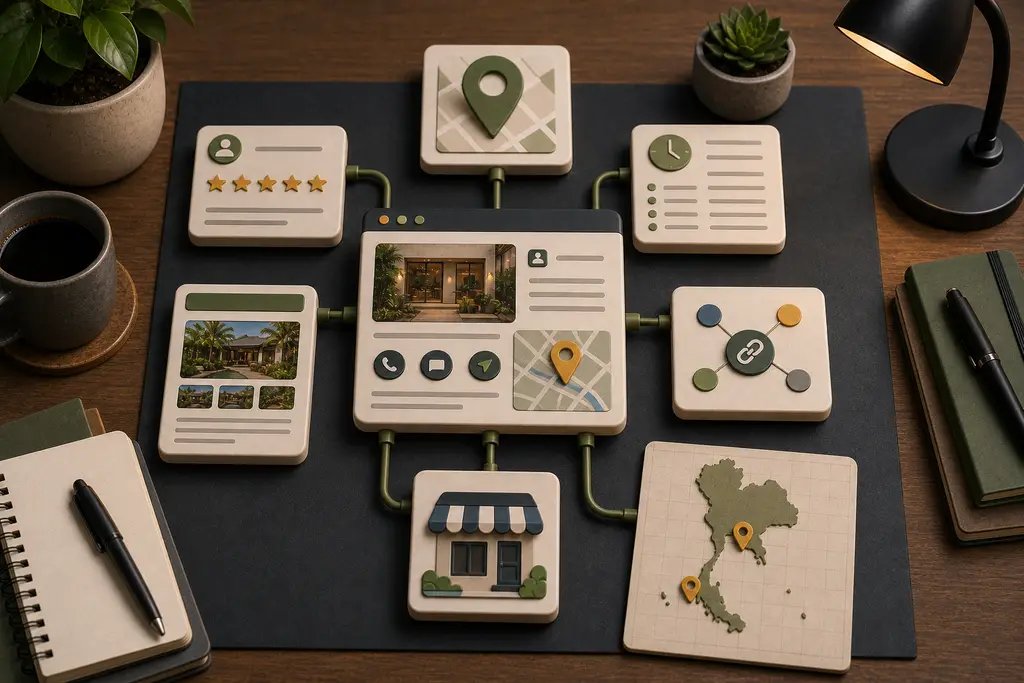
For many local businesses, the website and business profile should support each other. The website gives depth: services, cases, pricing context, FAQs, booking or enquiry flows, and technical trust. The profile helps people find the business in local search and maps.
Keep the basics consistent: name, contact details, service descriptions, opening expectations, and location information. If the business works remotely or by appointment, say that clearly instead of implying a physical office that does not exist.
For Webstudiet, the locality claim stays factual: direct technical help for Thailand-related businesses, not an invented agency office.
Avoid doorway-page thinking
Local SEO becomes weak when pages are created only to capture small variations of a query. A small business site should not publish dozens of almost identical pages that funnel visitors to the same contact form.
Instead, create pages that match real intent. A villa rental website, restaurant website, legal service site, and developer service page need different content because customers make different decisions.
This also protects the site from internal competition. The article on keyword cannibalization on small websites explains why small sites need one clear page per intent.
Use internal links deliberately
Local pages should not be isolated. Link from service pages to relevant cases, related articles, contact routes, and supporting technical explanations.
For a Thailand tourism or booking project, a case such as Thailand-villas.com or klik.villas can provide useful context. For content architecture and internal linking, WhyBangkok.com is a current example.
Use descriptive anchor text and place links where they help the reader. That is more useful than adding a block of keyword links at the bottom of every page.
Frequently Asked Questions
We serve a whole region rather than one address. How should that be set up?
Describe the service area honestly on one strong page instead of splitting it into a page per district. Say where you actually travel, what the travel time or delivery model means in practice, and where you do not go. A business profile can be configured as a service-area business rather than one with a walk-in address, which fits a remote or appointment-based operation far better than publishing a location nobody visits.
Do we need a Thai-language version to show up in local search?
It depends on who you need to reach. A business selling to expats, tourists, and overseas buyers can do well in English alone. One selling to Thai residents, staff, or local partners is competing for searches typed in Thai, and an English-only site cannot appear for them. That is a decision about the customer rather than ranking mechanics. If you do add Thai, it needs its own metadata and route structure rather than an auto-translate widget.
Technical quality still matters
Local SEO depends on the same technical basics as any other search work: crawlable pages, clear titles, useful headings, fast loading, mobile-friendly layouts, descriptive internal links, and metadata that matches visible content.
Structured data can support local business details when the visible page actually contains that information. It should not invent reviews, addresses, services, or availability.
If you need help improving local search visibility for a Thailand business, start with the real service structure. Then contact me if you want a technical review focused on crawlability, internal links, performance, and maintainable content.