- Published
- Updated
Setting up as a digital nomad in Thailand
Thailand attracts remote workers, freelancers, developers, and small business owners for good reasons. Bangkok, Chiang Mai, Phuket, and other places offer the mix people look for: infrastructure, food, climate, community, and lower operating costs than many Western cities.
The subject is personal for me. I lived in Thailand for fifteen years, and travelling slowly for long stretches is still something I would like to do; I have written about that ambition and where it came from separately. This article is about the practical side: what has to be true before a technical business can move at all.
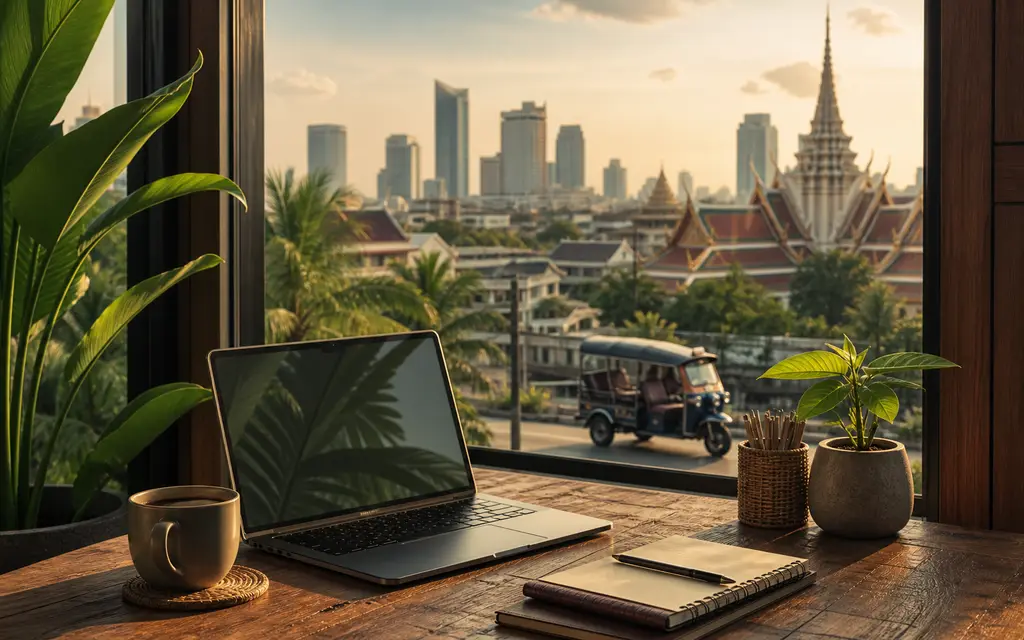
Thailand is the location, not the business model
Moving to Thailand does not fix weak sales, unclear pricing, poor delivery, or fragile systems. It can make life better, but it does not make the business run by itself.
For a developer, consultant, SEO specialist, or small technical business, the important questions are concrete:
- Can clients reach you without needing same-day meetings?
- Can work be scoped and delivered asynchronously?
- Can you invoice and get paid reliably?
- Can you deploy, debug, and support systems from another time zone?
- Can you handle legal, visa, tax, and insurance questions without guessing?
If those parts are not under control, Thailand becomes a distraction instead of an advantage.
Start with clients before you start with flights
The safest digital nomad setup starts before leaving.
For a web developer, that means building a client base and workflow that does not depend on being physically nearby. The work should already be possible through email, GitHub, issue tracking, scheduled calls, clear estimates, and written decisions.
This is also why existing technical relationships matter. If clients already trust how you work, location becomes less important. If they do not, moving abroad adds friction before the collaboration has earned enough trust.
Check the legal route instead of assuming
Since 15 July 2024, Thailand has had a visa route explicitly intended for this kind of stay. The Destination Thailand Visa was introduced for remote workers, digital nomads, and freelancers as well as several other eligible activities. The official Thai e-Visa site places it under “Workcation and Thai soft power related activities”.
The DTV is valid for multiple entries over five years and permits a stay of up to 180 days per entry, according to the Royal Thai Embassy in Copenhagen. Its current workcation requirements include financial evidence and proof of foreign employment, remote work, or freelance activity.
It is often described as Thailand’s digital nomad visa, but I would not describe it as a general Thai work permit. It is a route for a stay built around remote work or freelance activity; taking employment with a Thai company is a separate legal question.
The DTV makes Thailand much more practical as a base, but it does not mean every remote worker automatically qualifies. Requirements can vary by embassy or change over time. Before planning a long stay, check the official Thai e-Visa information and the relevant embassy or consulate instructions.
For longer-term plans, Thailand also has the Long-Term Resident visa route for Work-from-Thailand professionals. The official BOI LTR site describes this as remote work for well-established overseas companies. That route is different from a simple freelancer setup and should be checked carefully before relying on it.
The main point is simple: do not build a business plan on forum summaries or old visa blog posts. Verify the current rules, and get professional advice for tax and legal questions.
The setup that makes distance workable
A remote technical workflow should not depend on memory, chat fragments, or informal promises. Version control, clear task descriptions, separate development and production environments, backups, access management, and stable invoicing are what make distance manageable — and none of them are specific to Thailand. They are what any technical collaboration needs once the people involved are no longer in the same room.
If a client needs a WordPress fix, an API integration, a Laravel adjustment, or technical SEO cleanup, it should not matter whether the work happens in Denmark, Bangkok, or somewhere else. What matters is that it is scoped, implemented, tested, and communicated properly. That is the part I can speak to from practice rather than ambition, and I describe it in how I work with clients across time zones.
Thailand as a real business context
Thailand is not only a lifestyle keyword for me. I have worked on Thailand-related web projects for years, including early villa rental websites, rental operations systems, and my current Bangkok city guide project.
Those cases matter because they connect location with actual technical work:
- Thailand-villas.com was early PHP booking-engine and SEO work around villa rentals.
- klik.villas focused on villa rental operations, economy, and channel integrations.
- WhyBangkok.com is a current Astro-based city guide platform for Bangkok.
That background makes Thailand more than an abstract digital nomad destination for me. It is a place connected to real projects and many years of work, which makes it a natural place to use as a base.
Frequently Asked Questions
Is the Destination Thailand Visa a Thai work permit?
Not as I read the official material. It places the DTV under workcation and remote or freelance activity, which is a different thing from permission to take a job with a Thai company. That remains a separate legal question, and one worth putting to a professional rather than a forum.
Can any remote worker stay in Thailand long-term without checking the visa rules?
Requirements vary between embassies and change over time, and not every remote worker qualifies for the DTV or the Long-Term Resident route. Check the current official sources before planning a long stay rather than relying on a summary written some time ago.
Digital nomad work still needs boring stability
The visible part of digital nomad life is the location. The part that makes it sustainable is the system behind it: clients, contracts, communication, code, deployments, documentation, backups, and realistic legal planning.
Thailand can be a good base, but only when the work is already stable enough to travel. If the goal is long-term freedom, the first job is not to move. It is to build work that travels well.