- Published
How to choose a web developer in Thailand
Choosing a web developer in Thailand should not begin with a visual portfolio alone. Design matters, but a website also needs to load quickly, work on mobile, handle forms and integrations, support content editing, and remain maintainable after launch.
For smaller businesses, the right developer is often the person who can understand the existing system, explain the tradeoffs, and make targeted improvements without turning every task into a rebuild.
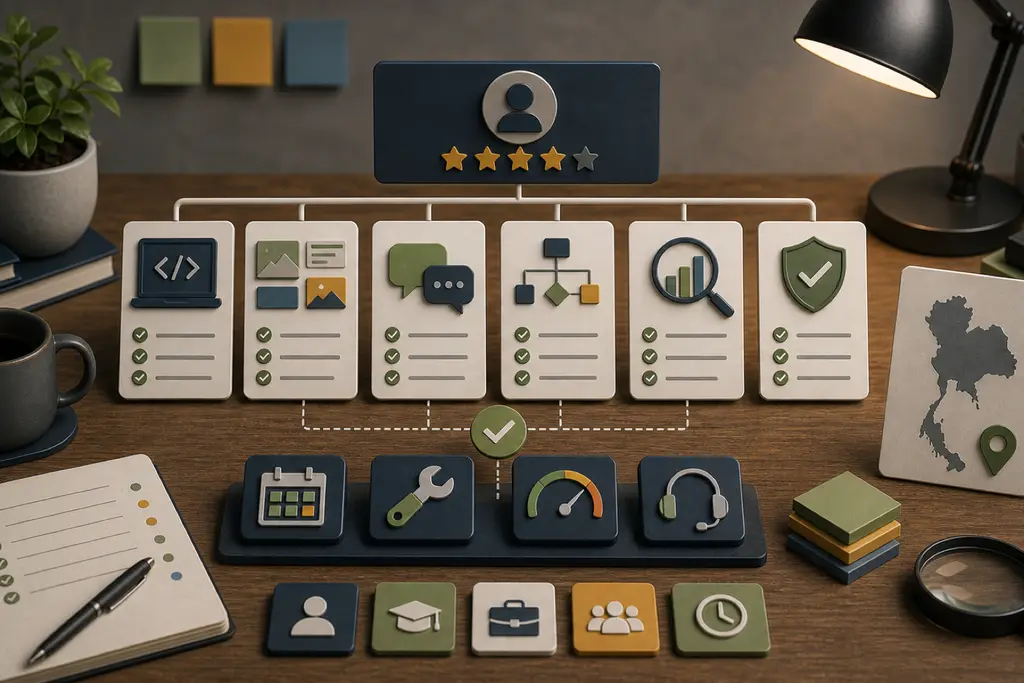

Look for relevant technical experience
Match the developer to the work. A brochure site, WordPress maintenance task, Laravel backend, booking integration, and technical SEO cleanup are different jobs.
Ask about experience with:
- Existing websites, not only new builds
- WordPress, PHP, Laravel, or the platform you use
- APIs, booking systems, and integrations
- Performance and Core Web Vitals
- Technical SEO, redirects, canonicals, and metadata
- Hosting, DNS, Cloudflare, and deployment
- Support and maintenance after the initial change
You do not need every skill for every project. You do need the skills that match the actual risk.
To see whether my experience fits your brief, see the web development services I offer for Thailand businesses, with examples of the work behind them.
Ask how they work
Process matters because it affects the result. A developer should be able to explain how work is scoped, implemented, tested, and released.
Useful signs include:
- Written scope before implementation
- Clear assumptions and exclusions
- Version control for code changes
- Backups before risky work
- Testing on important user flows
- Notes about what changed
- Direct communication when a tradeoff appears
This is especially important when collaboration is remote. Good process makes distance less relevant.
Be careful with vague promises
Avoid broad claims that sound good but are hard to verify: guaranteed rankings, instant speed, complete automation, or a perfect rebuild without tradeoffs.
Good technical work is more specific. It explains what will be checked, what can be improved, what depends on external systems, and what cannot be promised.
For example, a developer can improve crawlability, metadata, internal links, and performance. They cannot honestly guarantee that Google will rank a page first.
Existing systems need respect
If the business already has a website, the developer should ask what must be preserved: URLs, rankings, booking flows, integrations, analytics, forms, and content workflows.
Rebuilding without understanding those details can create avoidable damage. Often the better first step is an existing website improvement plan or a focused website analysis.
Frequently Asked Questions
Should a portfolio be the main factor when choosing a web developer in Thailand?
No. Design matters, but a website also needs to load quickly, work on mobile, handle forms and integrations, and stay maintainable after launch. Relevant technical experience with your platform and existing systems matters as much as visual work.
What is a warning sign when talking to a prospective developer?
Broad, hard-to-verify promises such as guaranteed rankings, instant speed, complete automation, or a perfect rebuild without tradeoffs. A developer doing good technical work explains what will be checked and what depends on external systems instead.
Should an existing website always be rebuilt from scratch?
Not necessarily. A developer should first ask what must be preserved, such as URLs, rankings, booking flows, integrations, and content workflows. Often a focused improvement plan or a website analysis is the better first step than a full rebuild.
What should matter most after the website launches?
Whether content can be updated, another developer can understand the code, redirects are documented, integrations are monitored, and backups and deployment are clear. The real test of a website is what happens after the first version goes live, not just the launch itself.
Choose for maintenance, not only launch
The real test of a website is what happens after the first version is live. Can content be updated? Can another developer understand the code? Are redirects documented? Are integrations monitored? Are backups and deployment clear?
If you are choosing a web developer in Thailand, look for direct responsibility. The best fit is usually someone who can work directly with you, understand the technical foundation, and make the site more stable over time.
That is what smaller businesses usually need most: not more complexity, but clearer technical work that can be trusted. If you want a direct assessment of an existing Thailand website or a planned project, send me the current situation and the outcome you need.