- Published
How business profiles support local search visibility
Business profiles are a separate part of local SEO from service pages on the website. The website explains the business in depth. Profiles on Google, Bing, Apple Maps, and relevant directories help search systems and customers confirm that the business is real, contactable, and active in the right area.
For a Thailand business, this can matter for villa rentals, tour operators, restaurants, clinics, consultants, local service companies, and expat-owned businesses that depend on local or map-based discovery.
The goal is not to create as many listings as possible. The goal is to claim the important profiles, make the core details consistent, link them to the right website pages, and avoid profile spam that can damage trust.
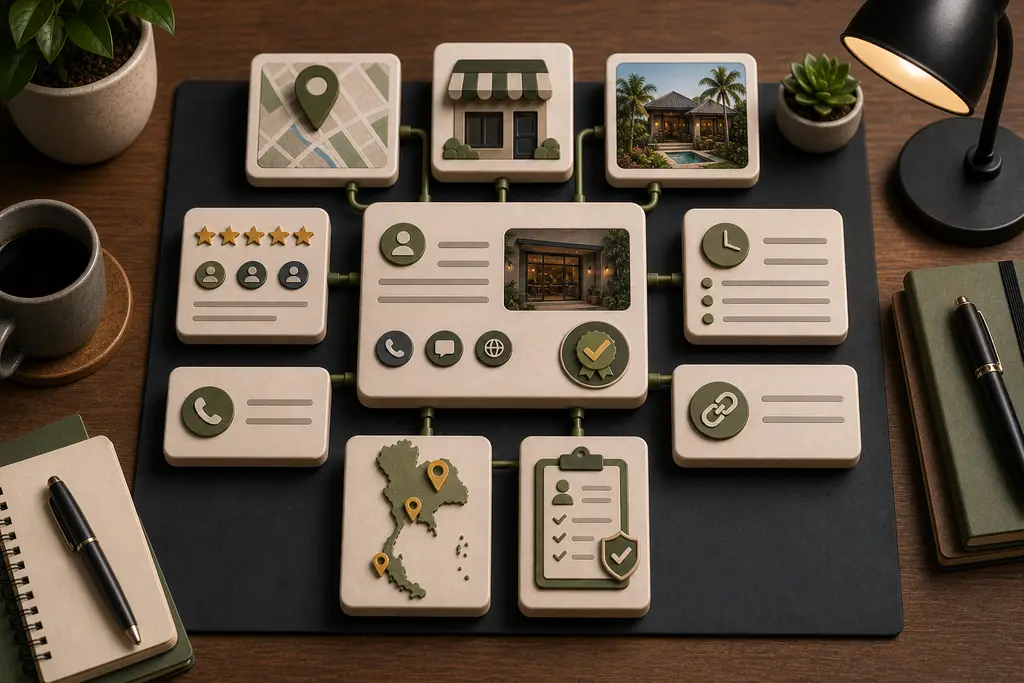
Start with one source of truth
Before creating or editing profiles, decide the business details that should be consistent everywhere.
For most businesses that means:
- Real business name
- Main phone number
- Website URL
- Physical address or service area
- Opening hours or appointment policy
- Primary category
- Short business description
- Logo and current photos
- Booking, enquiry, menu, or service links where relevant
This sounds basic, but it prevents many local SEO problems. A restaurant with different hours across platforms, a villa business with old phone numbers, or a service company with several versions of its name creates confusion for customers and search systems.
If the business has no staffed public office, do not invent one. Use the platform’s service-area or appointment-based options where they fit. A factual profile is stronger than a profile stretched to look more local than the business really is.
Claim the core profiles
Start with the profiles that can directly affect how people find and contact the business in maps and local search.
For most Thailand-focused businesses, the core set is:
Always search for an existing profile before creating a new one. If a profile already exists, claim it instead of adding a duplicate. Duplicates can split signals, confuse customers, and make ownership harder later.
Keep ownership under an account the business controls. An external developer, SEO consultant, or agency can help with setup, but the business should not lose access if that working relationship ends.
Use categories and areas carefully
Categories are not a place to add every keyword. They should describe what the business actually is.
Google’s Business Profile guidelines say to use as few categories as needed to describe the core business, and not to use categories only as keywords. That is the right principle across platforms.
The same applies to location and service area. A company serving Bangkok, Phuket, Chiang Mai, Pattaya, or Hua Hin should describe the real area it can serve. A villa rental or tour operator can mention the real destination. A remote consultant should make the remote delivery model clear instead of implying a walk-in office.
The related guide on local SEO for Thailand service businesses covers the website-side version of this problem: real service pages beat thin city pages.
Fill profiles with useful evidence
A claimed profile with only a name and phone number is weak. Complete the fields that help a customer make a decision.
Useful profile content can include:
- A concise description of the business
- Current photos of the premises, work, team, products, or setting
- Services, products, menus, rooms, packages, or appointment options
- Opening hours, holiday hours, and seasonal notes
- Booking or contact links
- Accessibility, parking, payment, or language details if the platform supports them
Reviews matter because they provide public evidence from real customers. Ask for reviews only where the platform rules allow it, and never fake, buy, or filter reviews. Responding calmly to reviews is usually more useful than trying to make the profile look perfect.
Connect profiles to the website
Profiles should point to the right website page. A simple business may use the homepage. A restaurant may use a menu or reservation page. A villa rental business may use the main villa search or enquiry flow. A service company may use the relevant service page.
The website should support the same facts:
- Name, phone, and contact route match the profiles
- Address or service area is explained honestly
- Opening hours or response expectations are visible where relevant
- Important services have clear pages
- Contact, booking, and enquiry flows work on mobile
Structured data can help when it matches visible content. Google’s LocalBusiness structured data documentation shows how business details can be marked up, but structured data should not invent reviews, addresses, opening hours, or services that are not visible and true.
Choose secondary profiles deliberately
Other profiles can help when they match how customers actually discover the business. That may include tourism platforms, booking sites, industry directories, review platforms, chamber or association listings, and maintained social profiles.
Do not treat every directory as valuable. Low-quality citation packages often create stale listings, duplicate logins, wrong phone numbers, or descriptions nobody maintains. A few accurate, relevant profiles are better than many weak ones.
For Thailand tourism and hospitality projects, this connects naturally with website quality. A profile can send a visitor to the site, but the site still has to load quickly, explain the offer, and make enquiry or booking easy. The Thailand-villas.com case is an older example of how location, property data, booking flow, and SEO structure can sit together.
Maintain profiles after setup
Local profiles are not a one-time task. Review them when the business changes phone number, hours, address, booking system, services, menu, season, or ownership.
A sustainable maintenance rhythm is:
- Keep a list of claimed profiles and login owners.
- Check the core profiles after any business change.
- Review photos, service links, and descriptions a few times per year.
- Check that profile links still lead to live website pages.
- Watch for duplicate profiles or suggested public edits.
- Keep Search Console and analytics connected so website traffic and enquiries can be evaluated separately from profile views.
For the search-tool side, Google Search Console vs Bing Webmaster Tools explains why a serious site should compare more than one data source.
Frequently Asked Questions
Should a business create as many local profiles as possible?
No. The goal is to claim the important profiles, keep the core details consistent, and link them to the right website pages. Low-quality citation packages and unnecessary directories often create stale listings and descriptions nobody maintains.
What should a business do if a profile already exists but nobody has access to it?
Search for the existing profile before creating a new one and claim it instead of adding a duplicate. Duplicates split signals, confuse customers, and make ownership harder to sort out later.
Should a remote or service-area business list a physical office address?
No, not if it does not have a staffed public office. Use the platform’s service-area or appointment-based options instead. A factual profile is stronger than one stretched to look more local than the business really is.
Do local business profiles replace the need for a good website?
No. Profiles are trust and discovery signals, not a substitute for a useful website, real service pages, clear contact paths, and technically sound structured data that matches what is visible on the page.
Use profiles as trust signals, not shortcuts
Business profiles can support local visibility, but they do not replace a useful website, real services, clear contact paths, and technically sound pages. They are trust and discovery signals, not a loophole.
Current official guidance points in the same direction: create or claim real business profiles, verify ownership, represent the business accurately, keep categories and areas honest, and avoid manipulative search tactics.
Useful official references:
If a Thailand business needs a focused review of profiles, website pages, tracking, and technical SEO together, send me the website and the current profile links. I can review it in context and keep the focus on accurate visibility, not listing spam.